Meta Description: Discover how AI is transforming digital marketing in 2026, including AI tools, SEO, content creation, paid ads, personalization, automation, and future trends.
Primary Keyword: AI in digital marketing 2026
Secondary Keywords: AI marketing tools 2026, AI digital marketing trends, AI marketing strategies, artificial intelligence in digital marketing, AI marketing automation, AI-powered SEO, AI content marketing, future of digital marketing
Introduction
What if your marketing team could analyze thousands of customer interactions, create multiple content ideas, optimize advertising campaigns, predict customer behavior, and personalize communication—all before your competitors finish their weekly marketing meeting?
That is the direction digital marketing is taking in 2026.
AI in digital marketing 2026 is no longer simply about generating blog posts or writing social media captions. Artificial intelligence is becoming part of the entire marketing journey—from discovering customer intent and creating content to running campaigns, analyzing results, and improving customer experiences.
For businesses, the real question is no longer “Should we use AI?”
It is:
“How can we use AI without losing the human creativity, strategy, and trust that make a brand valuable?”
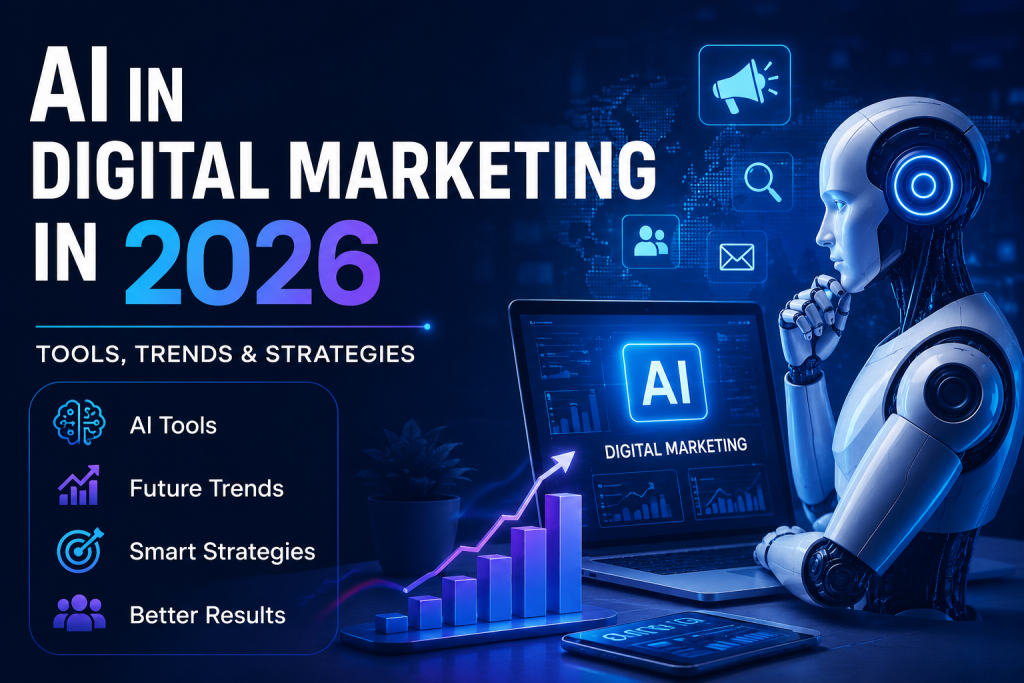
In this guide, we’ll explore the biggest AI digital marketing trends, useful AI marketing tools, practical strategies, benefits, challenges, and the future of AI-powered marketing.
What Is AI in Digital Marketing?
AI in digital marketing means using artificial intelligence, machine learning, generative AI, predictive analytics, and automation to improve marketing activities.
Instead of relying only on manual research and assumptions, marketers can use AI to identify patterns in large amounts of data and make faster decisions.
For example, AI can help a business:
- Identify potential customers
- Analyze customer behavior
- Generate content ideas
- Personalize email campaigns
- Optimize advertising campaigns
- Predict customer intent
- Automate repetitive marketing tasks
- Analyze social media sentiment
- Improve SEO strategies
- Provide instant customer support
The important shift in 2026 is that AI is moving from being a content assistant to becoming a marketing decision and workflow assistant.
7 Ways AI Is Transforming Digital Marketing in 2026
1. AI Is Taking Personalization to the Next Level
Customers don’t want generic messages.
They want brands to understand their needs, interests, previous interactions, and buying stage.
AI can analyze customer behavior across websites, emails, advertisements, social media, and CRM data to create more relevant experiences.
For example, an e-commerce brand could show different product recommendations based on a customer’s previous purchases and browsing behavior.
Instead of:
“Check out our latest products.”
AI-powered personalization can help deliver:
“Because you liked our running collection, here are three new products selected for your fitness routine.”
This type of personalization can improve engagement and customer experience.
2. AI-Powered Content Marketing Is Becoming Faster
Content remains one of the most important parts of digital marketing, but the way marketers create it is changing.
AI marketing tools can assist with:
- Keyword research
- Blog outlines
- Content briefs
- Social media ideas
- Ad copy
- Email subject lines
- Video scripts
- Product descriptions
- Content repurposing
However, businesses should avoid publishing completely AI-generated content without human review.
The winning approach is:
AI + Human Expertise = Better Content
AI can help with speed and scale, while humans provide experience, opinions, originality, storytelling, fact-checking, and brand personality.
This is especially important because creating content is no longer enough. Brands need content that is useful, trustworthy, original, and genuinely relevant to the audience.
3. AI Is Changing SEO and Search Behavior
SEO is experiencing one of the biggest changes because users are increasingly getting information directly from AI-powered search experiences and conversational tools.
This means marketers should think beyond traditional keyword rankings.
Modern SEO strategies need to focus on:
- Search intent
- Helpful content
- Topical authority
- First-hand experience
- Structured information
- Brand credibility
- Natural language
- Entity optimization
- Frequently asked questions
- Clear and concise answers
For example, instead of creating an article only around:
“Digital marketing agency”
a brand can create a complete content ecosystem covering:
- What does a digital marketing agency do?
- How much does digital marketing cost?
- Which services does a business need?
- How to choose a digital marketing agency?
- SEO vs paid advertising
- Social media marketing strategies
- Digital marketing ROI
This helps build topical authority rather than relying on a single keyword.
The future of SEO is not simply ranking for keywords. It is becoming a trusted source of information.
4. AI Is Making Paid Advertising More Intelligent
Platforms such as Google Ads and Meta Ads increasingly use machine learning to optimize targeting, bidding, placements, and creative delivery.
AI can help marketers analyze:
- Audience behavior
- Conversion patterns
- Ad performance
- Customer segments
- Budget allocation
- Creative performance
- Conversion probability
For example, instead of manually testing dozens of audience combinations, marketers can provide high-quality conversion data and creative assets while AI-powered systems help identify opportunities.
But this does not mean marketers can launch campaigns and forget about them.
Human marketers still need to control:
Strategy → Creative Direction → Offer → Audience Understanding → Data Quality → Testing → Optimization
AI can optimize the system, but humans still need to decide what the business should communicate.
5. AI Chatbots Are Becoming Digital Sales Assistants
AI chatbots are moving beyond simple “How can I help you?” conversations.
Modern conversational AI can help businesses:
- Answer product questions
- Recommend products
- Qualify leads
- Schedule appointments
- Handle FAQs
- Support customers
- Collect customer information
- Guide users through purchasing decisions
Imagine a visitor landing on your website at 11:30 PM.
Instead of waiting until the next morning for a sales representative, an AI assistant could answer questions and guide the visitor toward the appropriate product or service.
For businesses that receive leads outside working hours, this can create a significant advantage.
6. Predictive Analytics Will Help Marketers Make Better Decisions
Traditional marketing often asks:
“What happened?”
AI-powered predictive marketing can also ask:
“What is likely to happen next?”
AI can analyze historical data to identify patterns related to:
- Customer churn
- Purchase probability
- Lead quality
- Customer lifetime value
- Demand forecasting
- Campaign performance
- Product recommendations
For example, a business may discover that customers who interact with certain content are more likely to purchase within 30 days.
Marketing teams can then create campaigns specifically designed for those high-intent users.
This turns marketing from a reactive activity into a more predictive and proactive process.
7. AI Agents Could Change Marketing Workflows
One of the most important AI digital marketing trends in 2026 is the rise of AI agents.
Unlike a basic chatbot that responds to a single prompt, an AI agent can potentially perform multiple connected tasks.
For example, a marketing workflow could look like:
Research → Analyze competitors → Find keywords → Create brief → Generate content variations → Review performance → Recommend optimization
The goal is not to replace the marketing team.
The goal is to reduce repetitive work so marketers can spend more time on:
- Strategy
- Creativity
- Brand building
- Customer understanding
- Experimentation
- Business growth
This shift toward AI-assisted workflows is becoming an important part of the broader future of marketing.
Best AI Marketing Tools in 2026
The right tool depends on the marketing problem you are trying to solve.
| Marketing Activity | AI Tool Category | What It Helps With |
|---|---|---|
| Content creation | Generative AI | Ideas, drafts, variations |
| SEO | AI SEO platforms | Keywords, content optimization, research |
| Advertising | AI ad platforms | Bidding, targeting, creative testing |
| Customer support | AI chatbots | FAQs, support, lead qualification |
| Email marketing | AI automation | Personalization and segmentation |
| Analytics | Predictive analytics | Forecasting and customer insights |
| Social media | AI social tools | Content planning and optimization |
| Video marketing | AI video tools | Scripts, editing and creative variations |
The best AI marketing stack isn’t necessarily the one with the most tools.
It is the one that solves your biggest marketing problems efficiently.
How to Build an AI Marketing Strategy in 2026
Simply subscribing to AI tools won’t transform your marketing.
You need a strategy.
Step 1: Define Your Marketing Goal
Start with a measurable objective.
For example:
- Generate more qualified leads
- Increase website conversions
- Reduce customer acquisition cost
- Improve engagement
- Increase repeat purchases
- Produce content faster
Don’t start with:
“We need AI.”
Start with:
“We need to solve this marketing problem.”
Step 2: Identify Repetitive Tasks
Look at your current marketing workflow.
Which tasks consume the most time?
Examples include:
- Data collection
- Reporting
- Content research
- Social media scheduling
- Customer FAQs
- Email segmentation
- Ad variations
These are excellent areas to test AI automation.
Step 3: Improve Your Data
AI is only as useful as the information it receives.
Poor-quality data can lead to poor recommendations.
Businesses should organize and maintain reliable:
- Customer data
- Website analytics
- CRM information
- Campaign data
- Sales data
- Conversion data
Privacy and responsible data handling should also remain a priority.
Step 4: Keep Humans in the Loop
Don’t automate everything.
A good AI marketing workflow looks like:
AI generates → Human reviews → Brand improves → Campaign launches → Data measures → AI assists optimization
This balance helps maintain quality, authenticity, and brand consistency.
Step 5: Measure ROI
Don’t measure AI success only by how much content you generate.
Measure business outcomes.
Track metrics such as:
- Leads generated
- Conversion rate
- Customer acquisition cost
- Return on ad spend
- Revenue
- Engagement
- Customer retention
- Time saved
The ultimate question is:
Is AI helping the business grow?
Benefits of AI in Digital Marketing
When implemented correctly, AI can provide several advantages.
Faster Execution
Tasks that previously required hours of manual work can often be completed much faster with AI assistance.
Better Personalization
AI can help businesses deliver more relevant messages to different customer segments.
Smarter Decisions
AI can analyze large datasets and identify patterns that may be difficult to detect manually.
Lower Operational Costs
Automating repetitive activities can reduce the amount of manual work required.
Better Customer Experience
AI chatbots, recommendations, and personalized communication can make customer journeys more convenient.
Scalable Marketing
Small teams can use AI to handle more marketing activities without increasing their workforce at the same rate.
Challenges of AI Marketing
AI is powerful, but it is not risk-free.
Businesses need to consider:
Data Privacy
Customer information must be collected and used responsibly.
Incorrect Information
AI can produce inaccurate or misleading information, so human review is essential.
Brand Voice
Generic AI-generated content can make different brands sound exactly the same.
Over-Automation
If every customer interaction feels automated, businesses can lose the human connection that builds trust.
Skill Gaps
Marketing teams need to learn how to use AI effectively rather than simply adding more tools to their workflow.
The goal should not be maximum automation.
The goal should be maximum useful automation.
What Is the Future of Digital Marketing With AI?
The future of digital marketing will likely be a combination of artificial intelligence and human intelligence.
AI will increasingly handle:
Data → Analysis → Automation → Prediction → Optimization
Humans will continue to lead:
Strategy → Creativity → Empathy → Brand → Relationships → Business Decisions
We are also likely to see greater use of multimodal marketing, AI-powered search experiences, automated workflows, predictive personalization, conversational commerce, and AI-assisted creative production.
Marketing teams that learn to combine these capabilities can move faster while maintaining a strong customer focus.
Final Thoughts
AI in digital marketing 2026 is not about replacing marketers. It is about changing what marketers spend their time doing.
The businesses that benefit most from AI will not necessarily be the businesses using the largest number of tools.
They will be the businesses that understand their customers, use reliable data, choose the right technology, maintain human oversight, and continuously measure results.
Think of AI as a marketing partner—not a replacement for marketing strategy.
The future belongs to brands that can combine technology, creativity, data, and human understanding.
Frequently Asked Questions
1. How is AI changing digital marketing in 2026?
AI is transforming digital marketing through personalization, predictive analytics, content assistance, advertising optimization, automation, conversational marketing, and AI-powered search.
2. What are the best AI marketing tools in 2026?
The best tools depend on your objective. Marketers can use AI platforms for content creation, SEO, advertising, analytics, email marketing, social media, customer support, and video production.
3. Will AI replace digital marketers?
AI is more likely to automate repetitive marketing tasks than completely replace marketers. Human strategy, creativity, empathy, brand understanding, and decision-making remain important.
4. How can small businesses use AI for marketing?
Small businesses can start with practical use cases such as content research, social media creation, email personalization, customer support, reporting, and advertising optimization.
5. Is AI-generated content good for SEO?
AI can assist with content creation, but publishing generic AI content without adding expertise, originality, useful information, and human review is not a strong long-term SEO strategy.
6. What is the biggest AI marketing trend in 2026?
One major shift is the move from simple AI assistance toward integrated AI-powered workflows and agents that can help marketers perform multiple connected tasks. At the same time, AI-powered search is changing how users discover and evaluate information.
Ready to Make AI Part of Your Digital Marketing Strategy?
AI is changing the marketing landscape—but using AI effectively requires more than simply opening an AI tool and entering a prompt.
Build a strategy around your business goals, customer journey, data, content, and measurable results.
Want to make your digital marketing smarter, faster, and more effective in 2026? Start by identifying one repetitive marketing task you can improve with AI today.